

Exeter Architectural Products contracted a nationally known, independent testing laboratory to determine the shading coefficient of STORM SHIELD™ Hurricane Barriers and the effect installation of the barriers would have on solar heat gain.
Shading Coefficient of .51
The testing determined the shading coefficient of STORM SHIELD to be .51. The shading coefficient represents the percentage of solar heat gain that is transmitted to the interior of a structure through the glass and shading system; the shading coefficient for clear glass is 1. This means that, for a given opening, solar heat gain is reduced by almost 50%.
Reducing solar heat gain is a practical method for saving energy. For example, just sixty square feet of glass can admit as much as 12,000 BTU of heat each hour – roughly the capacity of one extra ton of air conditioning. By installing STORM SHIELD™ Hurricane Barriers over the existing glass, the amount of solar heat being introduced through the opening is reduced by almost 50%.
Clear Sky Solar Heat Gain – Miami, Florida
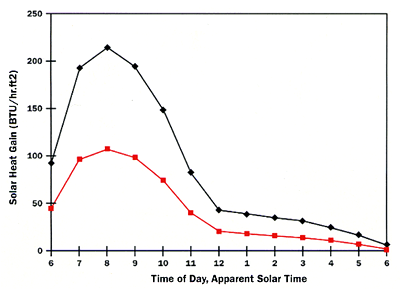
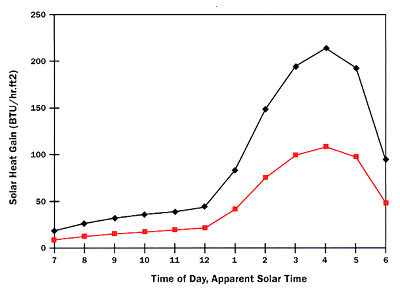
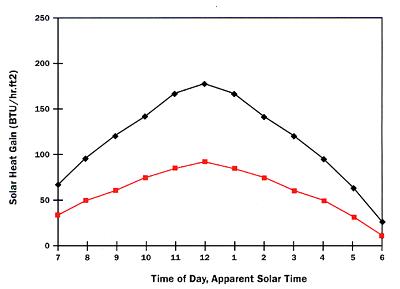
The following table represents the solar heat gain for 1/8" clear glass (ASHRAE reference glazing) and 1/8" clear glass protected by a STORM SHIELD™ Hurricane Barrier. Conditions were simulated for July 21st in Miami, Florida, for east, south and west facing openings.
| Time (AST) | East surface | South surface | West surface | |||
|---|---|---|---|---|---|---|
| 1/8" clear | with STORM SHIELD | 1/8" clear | with STORM SHIELD | 1/8" clear | with STORM SHIELD | |
| 7 AM | 193 | 98 | 18 | 9 | 18 | 9 |
| 8 AM | 215 | 109 | 27 | 14 | 26 | 13 |
| 9 AM | 195 | 100 | 34 | 17 | 32 | 16 |
| 10 AM | 149 | 76 | 40 | 21 | 36 | 18 |
| 11 AM | 83 | 42 | 47 | 24 | 39 | 20 |
| Noon | 43 | 22 | 50 | 26 | 43 | 22 |
| 1 PM | 39 | 20 | 47 | 24 | 83 | 42 |
| 2 PM | 36 | 18 | 40 | 21 | 149 | 76 |
| 3 PM | 32 | 16 | 34 | 17 | 195 | 100 |
| 4 PM | 26 | 13 | 27 | 14 | 215 | 109 |
| 5 PM | 18 | 9 | 18 | 9 | 193 | 98 |
| 6 PM | 7 | 3 | 7 | 3 | 91 | 46 |
| Daily total | 1036 | 526 | 389 | 199 | 1120 | 569 |
- Time is given in Apparent Solar Time (AST).
- 1/8" Clear = 1/8" clear ASHRAE reference glazing.
- With STORM SHIELD = 1/8" clear glass with a STORM SHIELD barrier on the outside.
- Testing and data supplied by Tait Solar Co., Inc., Tempe, Arizona.
- Daily totals are the sum of the hourly values shown.
Solar Heat Gain Reduction Charts
What This Means for a Building
The east and west elevations receive the highest peaks: on an east facing window in Miami, clear glass admits about 215 BTU per square foot per hour at 8 AM, while the same glass behind a STORM SHIELD barrier admits about 109. Because the barrier works as an exterior shade, the heat is stopped before it reaches the glass, which is more effective than interior blinds. Left in place year round, a hurricane barrier can therefore reduce cooling loads every sunny day, not only during storm season. For a broader look at exterior shading, read perforated metal screens for sun control and energy savings.